
You’ve launched a marketing campaign across email, social media, and paid ads. Traffic is coming in, but which channel is actually driving results? Without proper tracking, you’re flying blind. UTM parameters solve this problem by tagging your links with tracking information.
What Are UTM Parameters?
UTM parameters are simple text tags you add to the end of a URL. When someone clicks that tagged link, your analytics tool captures the information and shows you exactly where the visitor came from.
UTM stands for “Urchin Tracking Module” — named after Urchin Software, which Google acquired in 2005 to create Google Analytics. The tracking method stuck around and became the industry standard.
A UTM-tagged URL looks like this:
https://example.com/landing-page?utm_source=facebook&utm_medium=social&utm_campaign=spring_saleEverything after the ? contains your tracking parameters.
The 5 UTM Parameters Explained
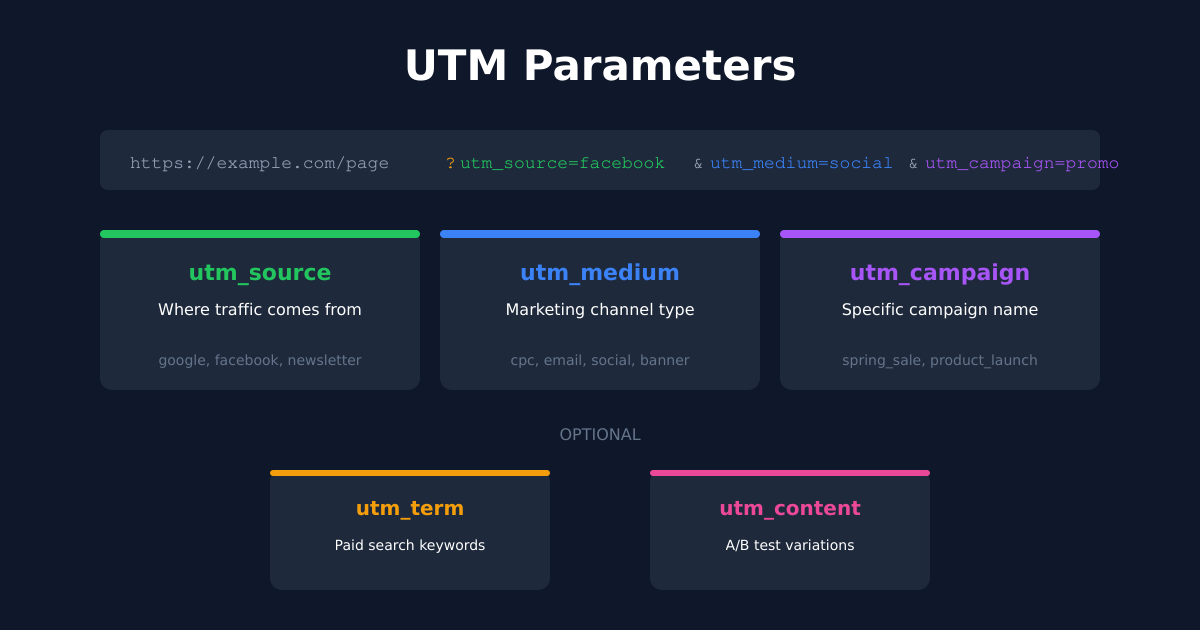
There are five UTM parameters you can use. Three are required, two are optional:
Required Parameters
utm_source — Identifies where the traffic comes from. Examples: google, facebook, newsletter, twitter.
utm_medium — Describes the marketing medium or channel type. Examples: cpc, email, social, banner.
utm_campaign — Names your specific campaign. Examples: spring_sale, product_launch, black_friday_2026.
Optional Parameters
utm_term — Tracks paid search keywords. Useful for identifying which keywords drive traffic in PPC campaigns.
utm_content — Differentiates similar content or links within the same campaign. Great for A/B testing different ad creatives or button placements.
How to Create UTM Links
You can build UTM links manually, but it’s easier to use a tool. Google provides a free Campaign URL Builder that generates tagged URLs for you.
Here’s a practical example. Say you’re promoting a blog post through three channels:
| Channel | UTM Parameters |
|---|---|
| Email newsletter | utm_source=newsletter&utm_medium=email&utm_campaign=weekly_digest |
| Facebook post | utm_source=facebook&utm_medium=social&utm_campaign=weekly_digest |
| Google Ads | utm_source=google&utm_medium=cpc&utm_campaign=weekly_digest |
All three links point to the same page, but your analytics will show traffic from each source separately. This data helps you understand which channels perform best — essential for attribution modeling.
UTM Best Practices
Follow these guidelines to keep your tracking clean and useful:
Use lowercase consistently. UTM parameters are case-sensitive. “Facebook” and “facebook” appear as different sources in your reports. Stick to lowercase to avoid splitting your data.
Create a naming convention. Document your standard values for sources, mediums, and campaigns. Share this with your team to maintain consistency.
Use underscores, not spaces. Spaces in URLs become “%20” which looks messy. Use underscores (spring_sale) or hyphens (spring-sale) instead.
Don’t use UTMs for internal links. Adding UTM parameters to links within your own site breaks session tracking and inflates your traffic numbers. UTMs are for external campaigns only.
Keep campaign names descriptive. Six months from now, will you remember what “campaign_1” meant? Use clear names like “summer_sale_2026” or “ebook_launch_analytics”.
Viewing UTM Data in Analytics
In Google Analytics 4, find your UTM data under Reports → Acquisition → Traffic acquisition. You’ll see sessions broken down by source, medium, and campaign.
You can also create custom reports to analyze specific campaigns or compare performance across channels. This data becomes even more valuable when combined with audience segmentation to understand how different user groups respond to your campaigns.
Common UTM Mistakes to Avoid
Inconsistent naming — “fb” vs “facebook” vs “Facebook” creates three separate sources. Pick one and stick with it.
Missing parameters — Forgetting utm_medium means your traffic shows up as “(not set)” in reports, making analysis harder.
Overly complex tags — You don’t need 10 parameters. Keep it simple with source, medium, campaign, and occasionally content for A/B tests.
Start Tracking Your Campaigns
UTM parameters are one of the simplest yet most powerful tools in your analytics toolkit. They take minutes to set up and provide clarity on which marketing efforts actually drive results.
Start with your next campaign: tag your links, check your analytics after a week, and see exactly where your traffic comes from. You might be surprised which channels outperform your expectations.